Printed Editions


Download our Printed Editions
Volume: 1.1 1.2

Wednesday, March 16, 2011

Reification - The Self-Alienation of Bourgeois Consciousness


We live in a capitalist system founded upon economic relations, where the commodity structure has “penetrated society in all its aspects and remolded it in its own image”.  The essence of this condition is that our actions, rather than appearing as our authentic, creative presence in the world, become labor – an alienated thing.  Losing all of its organic dynamicism, human activity is reified – given a ‘phantom objectivity’ disconnected from the individual – and man’s social relations are perverted into the sterile relations of commodities.  This reification transforms society into a system of economic production and consumption, and man into a sum of exchange-value and capital.  Human social existence becomes necessarily alienated from its true nature.

As Georg Lukács writes –

There is both an objective and a subjective side to this phenomenon.  Objectively a world of objects and relations between things springs into being (the world of commodities and their movements on the market).  The laws governing these objects are indeed gradually discovered by man, but even so they confront him as invisible forces that generate their own power.  The individual can use his knowledge of these laws to his own advantage, but he is not able to modify the process by his own activity.  Subjectively – where the market economy has been fully developed – a man’s activity becomes estranged from himself, it turns into a commodity which, subject to the non-human objectivity of the natural laws of society, must go its own way independently of man just like any consumer article


It is clearly demonstrated how the concept of reification is not only useful for students of Marxist political economy, but is of value for any serious critique of modern society. The reification of social relations under capitalism perverts our very experience of the world.  In man’s estrangement from authentic being through the objectification of his activity, he comes to view the interactions of these reified objects as the true nature of social existence. He becomes subjugated to the quantitative calculability of the commodity structure, and seeks to understand himself solely through this rational, ‘scientific’ system. “Just as the capitalist system continuously produces and reproduces itself economically on higher and higher levels, the structure of reification progressively sinks more deeply, more fatefully and more definitively into the consciousness of man”.  Capitalism thus produces a false consciousness that constantly reasserts its own self-alienation.  Lived, authentic experience is lost to the rational mechanization of reified forms, governed by laws and systems we believe to be objective.

Thus, the pervasive alienation of modern existence exhibits itself not only in the ostensibly economic sphere.  Capitalism has perverted every aspect of society, as well as modern man’s very consciousness.  The modern role of science is a clear example of the distorted nature of bourgeois consciousness. We live in an age of sterile positivism, where the majority of the educated population holds faith in the ability of science to understand human activity as a rational, logically approachable system.  Science, however, does not hold the privileged position that it so often claims.  Rather than engaging objective existence, our modern quasi-positivism is in fact concerned only with reified forms.  This is especially evident in the social sciences.  False bourgeois consciousness has historically reproduced the structure of economic reification in the practice of psychology and sociology.  By objectifying man’s thoughts and activities into scientifically interpretable things, these disciplines have further alienated modern man from his experience of the world. Lukács would regard these false relations, these structures of modern consciousness, as symptoms of capitalist commodification.  In regarding man as a psychological and sociological construct, we have further distanced ourselves from the organic, creative free play of human existence.

Exploring the reified structures of distorted consciousness calls us to reexamine the nature of our own presence in the world.  While the institution of liberal arts education professes an ideal of lofty personal striving and emancipation from unreflective, self-imposed immaturity, here among the self-satisfied sons of wealth and comfort we seem far more content to constantly reproduce reified social relations, rather than transcend self-alienated bourgeois values towards fullness and authenticity of being.

Modernity is an age of estrangement, where man’s objectified activity has been given alien autonomy and power over him.  Fullness of meaning, strength of voice and authentic being-towards-death – these values have no place in the false bourgeois consciousness of modern capitalism, where humanity is governed by rational, deterministic laws concerned only with the reified form of man.  It is clear that we must attempt to rise above this false consciousness to the phenomenological standpoint – and accordingly strive to recover our being from capitalism’s self-imposed alienation.


TYH

Monday, March 14, 2011

Know Your Rights: Dealing with the Cops


I despise the existence of cops. Plain and simple. You know my bias from the beginning, but I will try not to let that bias come through too much. My purpose here is to pass along some useful information.

Cops are not your friends. An individual police officer may be friendly, but that’s more a testament of their personal character and forces me to wonder “Why the fuck did s/he become a cop!?” Cops do not serve the people; they are the enemies of freedom and individuality. Their purpose is to maintain a hierarchical system based on subordination and to reinforce capitalism. I do not dislike individual cops because of the individual, but because that individual chose to support a system that is flawed and serves only to help the richest white individuals and corporations.

Regardless of how much I dislike the cops; I know that when they confront me, I need to act meek. “Yes sir.” “No, ma’am.” “No, I have no idea why you’re pulling me over.” Interaction with the cops is virtually unavoidable. If you are ever in a car there’s a chance you will be pulled over. Don’t have a car? Well, you’ll probably be stopped for hitchhiking in the wrong place, or biking where you are not supposed to bike. Or maybe you will happen to be in the wrong place at the wrong time and a cop will stop you and ask what you know, why you’re at the scene of the crime. Or maybe because s/he doesn’t like the way you look. Or maybe… the list goes on. What’s most important is that you know your rights when being confronted by the police.

In general, there are two key phrases you need to know.

The first is: “I am going to remain silent. I want to see a lawyer.”

Now, I know what you’re thinking. Why would I advocate speaking to a lawyer? Well, this is an extenuating circumstance. Invoke your Miranda Rights [1] by not speaking and demanding a lawyer. This way, the cop cannot use you against yourself. Plus, a lawyer will know the law better than any given individual, no matter how well informed we try to be.
An officer may not use your refusal to speak as an admittance of guilt. Probably, the cop will continue to ask you seemingly harmless questions. Do not answer them! Just repeat that you are going to remain silent and that you want to see a lawyer. The only thing that will come of you talking to cops is giving them more information than they originally had. Remember “Anything you say can and WILL be used against you” (emphasis mine).

The second key phrase is: “I do not consent to a search.”

Even if they have a search warrant, still use this phrase. You will never lose anything by invoking your right not to be searched. Plus, if they have a search warrant, and things are not totally in order, or if they search you without a warrant anyways, anything they find will be inadmissible in court.
It is important to remember that you need to state clearly, politely, and firmly that you do not consent to a search. In those terms. If you are not clear and do not stand your ground on this, the cops will do their best to get a casual consent. If a cop comes to your house, quickly exit and close the door behind you, assess what they want from outside, then invoke your key phrases as needed. If a cop asks you to step out of your vehicle, remember to close the door, or it may be seen as a form of consenting to a search. And always remember key phrase number 1, “I am going to remain silent. I want to see a lawyer.” If you are being detained, the only information you must give them is your name, address, age, birthday, and social security number until a lawyer arrives and advises you what to say.

These two phrases will help a lot. Though, not all cops will honor your rights. In these instances, stand as firm as possible in your refusal to speak. Even if you started speaking, you may invoke your Miranda Rights at any moment, and from that point forward you do not have to answer anything until your lawyer arrives.

It is also helpful to understand the different type of interactions with police. Midnight Special suggest 3 types of interactions:

1 ) Conversation: the cops are trying to get info and can’t soundly connect you to anything.
2 )  Detention: the cops had reasonable suspicion to hold you for questioning and you cannot leave. “Reasonable suspicion” means that the cop must be able to logically articulate why they are holding you.
3 ) Arrest: You can only be arrested when the cops have probable cause, meaning that they have more than reasonable suspicion. In other words, they have to be able to connect you to a crime to arrest you.

If you are arrested, you can still invoke your right to silence. At this point, the cops will do anything they can to get you to admit to committing a crime. They may use good cop/bad cop routine (remember, there is no such thing as a cop who is your friend), say they have some circumstantial evidence (which is most likely shaky at best; if it was a solid defense they would not have to question you), threaten a polygraph (lie detector) test, or one of their myriad other tactics. There is one surefire way to hold your ground, and that is to not speak.

Moreover, if you are involved in activism and direct action, be aware that a cop who has infiltrated your organization or who is undercover in the midst of protestors and activists does not have to identify him or herself. They can use many tactics to get you to get you to commit a crime without it being considered entrapment. (For instance, a Narc may take drugs so as to not blow their cover.) Just because they’re doing something illegal doesn’t mean they can’t and won’t nail you on the same activities. Be smart; don’t talk about illegal activity with those you don’t trust.

These may not apply to non-citizens or “illegal” immigrants. I am not totally sure and do not want to speak about anything I do not know about. There should be resources available on the internet regarding “illegal” immigrants’ rights when dealing with the cops. (If you do know resources, please post them in the comments!)

There are several resources available online concerning your rights when dealing with cops. Here are a few that I have consulted:

“Flex Your Rights” is a DVD you can purchase about knowing your rights when dealing with cops. However, there is also an FAQ on the website with concise chunks of information, as well as small video clips and some lectures about civilian rights when dealing with cops. You can check that out here: http://www.flexyourrights.com/

“Anarchist Survival Guide for Understanding Gestapo Swine Interrogation Mind Games” “Subtitle: Staying Free By Shutting the Fuck Up!” By Anarchist Author, Poet, Jailhouse Lawyer & Prisoner Harold H. Thompson. This is a pamphlet about, well about exactly what the title says. It stresses the importance of staying silent and goes over several police tactics.

“Dealing With Police” is a short, 4 page informational sheet from Midnight Special, a now-defunct legal collective. They have several resources available here: http://www.midnightspecial.net/materials/.

The Zine Library has a wide collection of articles, pamphlets, posters…etc. on prisons and police here: http://zinelibrary.info/english/prisons-and-police
A flyer from  The Zine Library: http://zinelibrary.info/files/enemies-police-v2.pdf

Injustice Everywhere: The National Police Misconduct Statistics and Reporting Project. http://www.injusticeeverywhere.com/

I realize that this article could cover many, many more aspects of dealing with cops. However, in most people’s daily lives, I feel that these key phrases and links will be the most useful. Feel free to suggest other tips for dealing with cops in the comments.

Oh yeah, and one final note, the key phrases above also work with any government agency (FBI, ICE, CIA…etc.).

[1] Interesting thing I learned about your Miranda Rights while looking up information about civilian rights when dealing with cops. Contrary to popular thought, a cop does not have to read you your Miranda Rights as soon as you are arrested. “The only time an officer must read a person his or her Miranda rights is when: (1) the person has been placed under arrest, AND (2) the officer is about to question the person about a crime” (http://flexyourrights.org/faq). Also, for those of you who may not recall exactly what the Miranda warning is, it reads, “You have the right to remain silent. Anything you say can and will be used against you in a court of law. You have the right to speak to an attorney. If you cannot afford an attorney, one will be appointed for you. Do you understand these rights as they have been read to you?”


- t h e  g a d f l y


-----


March 15 is the International Day Against Police Brutality. In the US, we may have a day reserved on October 22nd, but that does not mean that we should not support others on this day. Fuck police brutality. And fuck police. The cops are not your friends. http://en.wikipedia.org/wiki/List_of_cases_of_police_brutality

Saturday, February 26, 2011

Student Occupation in Glasgow: An Interview


For over a year, the British government has been cutting funding to public services, including university funding. Naturally, students are frustrated with the situation and do not want to see their education chipped away at because the government and university administrators do not deem certain aspects of it necessary. At Glasgow University in Scotland, this frustration has manifested itself as a student occupation of the Hetherington Research Club.

What follows is an interview, conducted via e-mail, with a student involved in the occupation. She does not speak for the whole occupation, but as an individual. It is a look into the anatomy of a student occupation and an example of what can be done through collective student power.

---

Middlebury Gadfly (MG): First, tell us what you can about the Free Hetherington. What is it? 

Hannah: The Hetherington Research Club (HRC) was, until last year, the postgraduate students' social club at the University of Glasgow. They ran various club nights and pub quizzes, and offered a space for postgraduate students to meet, get a drink, chat and learn form each other. Last year, the university shut it down, saying it was unprofitable and citing financial mismanagement issues. This meant the loss of a valuable space on campus, as although Glasgow Uni has two other student unions, neither offers the same relaxed atmosphere that the HRC did, and are geared more to undergraduates, drinking and club nights than they are to postgrads or to discussion and learning.

The building was occupied by students on the 1st of February, which means that at the time of doing this interview we're coming up for our one month anniversary in occupation, which is pretty cool! As far as I'm aware, what we're doing is pretty unusual in terms of UK student occupations, although there are numerous other student groups in occupation around the country right now.

Having this building, run autonomously, provides students and staff at Glasgow Uni with a valuable physical base for meeting and organising to fight the savage budget cuts at the universities in Glasgow. Since the 1st of February, the Free Hetherington has been run by students on donations, and we're open 24 hours a day. We have two people stationed on the door at all times for security reasons and to let people in. We offer free tea and coffee to all comers, and provide two free cooked vegan meals a day, prepared on site by our amazing volunteer chefs and helpers. Every day we run events, from direct action workshops and legal awareness training for demonstrators to life drawing and sewing classes. We even have children's film screenings! Everything at the Free Hetherington is decided at meetings where anyone can come and have their say and we vote on proposals democratically. 

MG: Budget cuts at Glasgow University prompted the occupation, correct? Can you tell our readers what the current situation is?
Hannah: The Tory-Lib Dem coalition government is cutting public services in a way that is just unprecedented in modern British history, and using the financial crisis as an excuse for cuts of an ideological nature. While Scotland isn't seeing the worst of this right now thanks to many of the issues involved being devolved to the Scottish Parliament, we have a general election here in May, which could see changes. As far as the current situation at the University of Glasgow goes, we're seeing extremely serious cuts proposed by senior management, who are proposing a “consultation” which will be overseen by the senior management team themselves before they confirm the drastic and frightening cuts that have been announced.

Currently they are proposing cutting the nursing department entirely, despite it being one of the best in the country with an excellent employment record for graduates. They are also proposing entirely cutting the school of Slavonic Studies, the only course of its kind in Scotland, which would include getting rid of Polish, Czech and Russian. German might also be for the axe. The most extreme proposal for the School of Modern Languages and Cultures (SMLC) would see language provision reduced to just French and Spanish, leaving the West of Scotland entirely without a university which provides a range of language options. They also want to merge archaeology with history, losing jobs. The scrapping of the Department of Adult and Continuing Education is also on the table, and this department has an important role to play in the wider community and as an access route to university for those without traditional academic qualifications. At the same time as they are proposing such drastic cuts in languages – an area in which Glasgow excels – they are investing in the departments which make the most money from non-EU students' fees, namely medicine, business and economics, and new professorships are being advertised in these areas while staff are being laid off elsewhere.

The Free Hetherington provides a space to organise protests against this destruction of our education, and we've had fantastic support from a broad base. Last week around 3000 students marched on the university court where management was meeting to discuss these proposals, the largest student demo Glasgow has seen. There is serious and broad-ranging opposition to the cuts being made and we will keep fighting. This is not just about our own educations; this is about the principle of education for its own sake, and the education of those who will come to Glasgow Uni in the future.

MG: When did the occupation start?
Hannah: On the 1st of February, a group of students occupied the abandoned building by entering through an unlocked fire door. No criminal damage was caused in entering the building. People have been in the building 24/7 since then.

MG: What are you hoping to achieve through this occupation?

Hannah: We want to see an end to the drastic cuts at Glasgow Uni, and to the government's ideological decimation of our public services. We also want to see the HRC return to being a building for student use, not turned into offices as the University wants. Additionally, though, we are building on the activist community in Glasgow, and providing an important space for people to meet with each other, discuss issues and organise. 

MG: Does a particular political/social ideology dominate the occupation, or is there a wide representation of views and goals?

Hannah: People here come from various political hues, from anarchists across numerous socialist denominations to people who're just opposed to the government's and the university's cuts, and although I think it would be fair to say we're a broadly left-wing group, we're certainly not party-political. Any disagreements are dealt with respectfully. People of any political ideology or none are welcome as long as they're open to respectful discussion. We try to be a respectful, safe space, and have firm policies against racist, sexist or homophobic behaviour.

MG: What is a typical day inside the Hetherington?

Hannah: It depends on the day! Those who've slept over wake up in the morning and put away communal bedding so the hall can be used for workshops and meetings. Coffee and tea is always going on in the bar downstairs (we don't serve alcohol, but you can BYOB!) and people will be popping in and out on their way to and from class, both regular users of the building and new people coming in to check it out. Someone will go out to get the papers so we can have them around for people to read. Some days meetings will be happening upstairs, for a variety of groups as anyone can book the space for free.

Throughout the day two people will always be on the door, in two-hour shifts. No one likes doing the 3-5am or the 5-7am, but someone always does! Lunchtime will come around and the chefs will bring up something tasty that anyone who wants can come in and eat, so we'll take some out to whoever's on the door. We also always have someone with medical and first aid training in the building, 24/7, who can often be found in the hallway by the medic station, and can otherwise be spotted by their fluorescent medic jacket!

In the evening we're usually a little busier. At least three nights a week we have an occupation meeting, where we gather to discuss issues and vote on things to do with the day-to-day running of the space. Dinner happens at various times whenever it's ready, and is always free, vegan-friendly and delicious! 

Throughout the evening people will come in to hang out and chat, or to attend a poetry open mic night or a pub quiz. Often people are up late in the hallway hanging out with the people on the door, singing and playing guitar or just chatting or knitting. It's a very friendly and open space, but also a place where people care and are passionate about things.

MG: Is it just students, or is the larger community encouraged to engage?

Hannah: The building is used by staff and both under- and postgrad students, and lecturers from the university have even come down to deliver free, open lectures. However, it's not exclusive to people from the university, and anyone is welcome to come in to attend events or just to check it out. The only exception is that we're not prepared to admit drunk or confrontational people who turn up the door. Also, obviously, police in uniform and the university security guards are not allowed into the building, although we do take the security guards cups of tea and coffee when they're outside, and we maintain a very good relationship with them. 

MG: What about administrators? Or police? Has there been any sort of conflict with those who are against you? If so, how did you handle it?

Hannah: We have been largely left alone in the building; I think the management was initially thinking we would get bored and leave quickly. Last week, the principal's PR man sent out an email to the entire staff and student body that made some pretty libelous and untrue statements about the occupation, asking us to end it. It should be noted that this mass email is the only communication we've ever had from senior management, who have never contacted the occupation directly and chose instead to make accusations and misrepresentations to a wide audience, while implying that they had had contact with us. We've released a reply, but we're being denied the right to send it out to the same mass audience that the principle was able to access, so we're trying to spread the word via Facebook and other social media. 

We have still not been directly asked to leave, and at the time of this interview we are attempting to set up a meeting with senior management to discuss our concerns.

MG: Is there anything else you’d like to share?

Hannah: For anyone who thinks of student activists as angry, hateful, violent people (and let me be clear – many people do think of us that way) the Free Hetherington is the opposite of that. We're a community space, for learning and discussion, and for fighting against the cuts, which will affect everyone at the University of Glasgow. It is an open place, where I've learned a lot and had my mind opened. We're providing a valuable service to the university and wider community, and it's just the happiest, most stimulating and encouraging place I've ever been lucky enough to spend time. I've met so many different people from around the world and from all walks of life, but everyone's voice has equal power within these walls. The people really do have power. Stand up and fight for what's important, and don't let governments and businessmen take it away.

----

For more information about the Free Hetherington, you can visit their website here:
or their Facebook page here: http://www.facebook.com/FreeHetherington

Solidarity from an american anarchist.

t h e   g a d f l y


*UPDATE* On 22 March 2011, the occupiers at The Free Hetherington were evicted by the police. The police gave a girl a concussion and refused her water and medical attention. Click the links above to find out more information as it is available.

Exploding cigar

This is from The Daily, Rupert Murdock's online only newspaper.

http://www.thedaily.com/page/2011/02/18/021811-opinions-oped-cuba-symmes-1-3/ 

Enjoy! 

Exploding cigar

Shortages and corruption make Havana regime vulnerable

Coffee is about to have less coffee in it, the Cuban government announced this month. It will now be adulterated with some as-yet-undetermined vegetable matter, stretching the country's meager supply of joe a little further.

All Cubans are issued a single small packet of coffee every month, as part of the state ration system, the cornerstone of government economic control. The richest coffee grown on the island is roasted dark, labeled for export and sold for hard currency in dollar stores few Cubans can afford. The lesser stuff, a brown powder sold under the Hola brand name, is rationed out, and is the only coffee most Cubans ever taste. Now it will be diluted, perhaps with ground nuts, soybean leaves or, as rumor had it during my visit to Cuba last year, ground twigs.

Coffee is a good measure of Cuban identity, one of the few pleasures that was never taken away by the revolution. A hot, sweet jolt, it is not just a stimulant, but a vital drink that controls appetite on an island where meals are infrequent.

The coffee crisis encapsulates all that is wrong with Cuba: theft, hunger, black markets, bad food and a leader who cannot produce beans but says twig-sipping is patriotic. Yet the Cuban Revolution goes on after half a century, unchallenged internally, because it holds not just the police truncheon, but also the trust of some portion of the population. Supporters are a minority, but not a small one.

Taking away the coffee is part of a deeper trend, however — one more failure at a moment when the cost of stagnation, one-party rule and endlessly accumulating small insults are being recalculated worldwide. Burma's generals must be nervous. Central Asian dictators are sniffing for smoke from Tahrir Square. And in Havana, the Cuban Revolution must know, deep in its old bones, that it is too weak to withstand a wave of popular unrest like that coursing through Egypt.

Today the Cuban economy is nonexistent or stagnant, the young are educated, broke and frustrated, and after 50 years of one-party rule, stealing and corruption have become aspects of everyday life. Sound familiar?

The Cuban state totters on the edge of bankruptcy. A million Cubans will be laid off, Havana says, but there are no jobs and business is effectively illegal. Soap, potatoes and peas have all been removed from the minimal rations that keep Cubans alive. Seventy percent of all food is imported. If the government goes broke, as seems increasingly likely, people will go hungry, and crime and corruption will increase. In such tense conditions, the bond between any given people and a once-revolutionary government can break quickly.

Adaptation is the stepchild of necessity. Havana is already full of foreign corporations (European and Canadian, primarily) involved in tourism or in the massive import trade necessary to keep a country alive when it cannot feed itself. With foreign entities handling hundreds of millions of dollars and most of the valuable goods in Cuba, some islanders inevitably get their fingers in the pie.

The average salary in the country is less than $20 a month, and corruption has long been endemic among the lower classes, with stealing from state employers the main mechanism. But now corruption is also appearing at the highest levels of society. In 2009, two of Cuba's senior leaders, Foreign Minister Felipe Perez Roque and Vice President Carlos Lage, were detained, humiliated at show trials and fired from the regime. Their offense appears to have been a luxurious, rum-fueled vacation with a wealthy Spanish lobbyist. In Cuba, political ambition and rivalry have always been involved in such purges. What is new is the certainty that, as the economy slips out of the regime's hands, large-scale financial corruption will be involved too.

Cubans mention the coming of corruption with certainty and fear: Top officials are already getting away with enriched lifestyles, and when this does become visible — larger houses, better cars and immunity from the police — then all bets are off. The regime fears financial corruption for a reason: It will break its bond with the Cuban public, a half-century-long narrative of all Cubans sacrificing equally. If some aren't sacrificing at all, that stings. If those people are high officials, it isn't a sting, it's a terminal disease. Hypocrisy was the downfall of Hosni Mubarak; the Cuban Communist Party could go the same way.

Most likely, it will be years before Cuban society confronts the crisis that unemployment, corruption and inequality will bring. But it starts now: A million Cubans will lose their state jobs before 2011 is over, simply because there is no way to pay them, nor any work for them to do. Left to their own devices, Cubans may develop successful ways of working, earning a living in one of the few narrow fields of self-employment allowed or on the traditional black market. Others will find new opportunities — if Cuba carries out a plan to provide raw materials and legalize the hiring of workers, many Cubans will become free of their total dependency on the state. However this economic future plays out, there is one certainty: Some will fall behind as others rise ahead, and in that gulf there is room for change.

What’s the American thing to do? Obama has embraced a Goldilocks policy, neither too hot nor too cold. He has increased cultural contact and eased restrictions on financial transactions. Both policies work against the Cuban government, disarming its propaganda and giving ordinary people some independence from the regime. Continuing the huge cash deals of the George W. Bush era for agricultural products — American exports of rice, wheat, apples and frozen poultry to Cuba have added up to $800 million in certain years — feeds the people while bankrupting the tyrannical state.

As for the faithful — the 7 percent of Cubans who are in "the Party" — they could try to hold tight. But the big bosses in Havana are already trying on their business suits, and today you can get an MBA at the University of Havana. The revolution has run out of patrons, and so business, with all its corruptions, is next. The new corruption will look very sour, very soon.

With such tinder, it takes only a spark: the capsizing of a fugitive boat, the immolation of a protester, the police revealed as criminals on viral video. Today's wave of popular unrest will be felt far from the Middle East.


TH(E) gadfly

Wednesday, February 23, 2011

Response to "How Nonviolence Protects the State by Peter Gelderloos"

This wouldn't fit in the comment box so I'm putting it up as a post...

--This critique is in reference to use of violent protest within the United States. I think that it may serve a very different and more effective role in other parts of the world--

This looks like a very good read. At face value, it seems to me that it makes some fairly strong arguments against the use of nonviolent protest. I would say, though, that a similar book could probably be written about how violent protest protects the state.

Violent protest seems to me to be fairly ineffective. For example, I would actually argue that the Black Panthers actually aided more in ending civil rights than being the unrecognized threat that brought about change. By the way, the Civil Rights Act of 1964 was passed two years before the formation of the Black Panthers in 1966. (I do think the Black Panthers had a lot to do with integration in police departments though)

Violent protest is racist. You don't think all those middle-class white kids wearing black bandanas, destroying property and fighting police (getting beat up by police) are not an exclusive and privileged group of people that perpetuate the systems of racism? There just like those middle-class white kids wearing peace signs, carrying signs and running from police: white, exclusive and privileged. I would say that the ones using violence are exploiting their privileges even more in certain ways. They feel it is their right to destroy the property of others without permission, and yes, it is usually a lot more than just a starbucks or a bank. They fuck up whole sections of cities, including lot's of private property belonging to everyday folk, and then just leave. Not to mention they have the privilege of being white if the time comes to go to court making it much easier to rationalize using violence (but usually they just hold you and let you go when the protests end).

"How can someone who has never felt the brunt of racism tell someone in Oakland, for instance, who has to deal with racist police, to just turn the other cheek when the cops will not hesitate to shoot and kill even unarmed citizens?"

How could they tell them to do anything violent? They don't understand the situation because they are white. Spreading the idea that violence is going to solve a situation you don't understand is just as counter-productive. Also, not just white folks preach nonviolence. The Civil Rights movement is an example of how many people of color were able to use "nonviolence" and that it wasn't only white folks preaching it (in fact most of the people involved in "nonviolent" protest were African American).

I would say that violent is statist as well. First, you are using a force that you deem illegitimate for the state to use. By using violence, you are legitimizing it as a tactic, for the state as well. Also, because you use it, they are allowed to respond to it with more violence. Thus, in the news the police are often portrayed as trying to maintain order against the illegitimate users of violence (protestors). Furthermore, it helps create a state of fear that the government and media effectively use to further strengthen their means of control. Not to mention, all those sweet guns, armor, smoke grenades and armored vehicles police departments get in preparation for big protests. It's not like those things are cycled throughout the country. Each department gets its own batch of brand new, dangerous shit.
A slightly different example is 9/11. I would deem it one of the most effective displays of violent protest in history (in terms of being seen). What did it do for the state? Oh, biggest defense budgets ever at the time they were signed, the Patriot Act, two wars, and a huge rise in patriotism and government support in the U.S. On top of that, a surge in world support for the U.S., a brutally oppresive government acting in all parts of the world (fortunately, that came to a quick end with Iraq). Oh, and way more racism against the Middle East as a whole. (i suppose it might be fair to argue about who planned the attacks...)

"In the chapter 'Nonviolence is tactically & strategically inferior', Gelderloos reiterates that nonviolence can only get a movement to a specific point, but to go beyond it and overthrow capitalism and all forms of oppression, they will need to escalate their methods."

I would say that statement is true for violent protest as well. To me, traditional protest (aka on the streets protest) "can only get a movement to a specific point, but to go beyond it and overthrow capitalism and all forms of oppression, they will need to escalate their methods." Violence isn't the thing we need to escalate.

I am not trying to say that violence is completely ineffective or that there isn't a place for it. Just that it also bears many of the same implications about aiding the state that "nonviolent" protest does as well. I would say I am pro "diversity of tactics" and a huge part of that is trying to find new forms of protest that are not traditional marches and protests, both violent and nonviolent. I fear the state has a bit too much control over us for these traditions to still be truly effective.

the GADFL(Y)

Monday, February 21, 2011

flyers

Feel free to print them out and post them. E-mail them. Reblog them. Do what you need to, but get the word out.


Monday, February 14, 2011

revival! revival! REVIVAL!

Hey all

This has been pretty dormant. But we're working on changing that. We're working on some new posts and generating some interested and interesting writers.

Are you interested in writing for the GADFLY? e-mail us. middlebury.gadfly [at] gmail [dot] com.

Politics. Art. Culture. Sexuality. Gender. Economics. Campus. Local. Global. we want your articles.


-the GADFLY

Tuesday, December 21, 2010

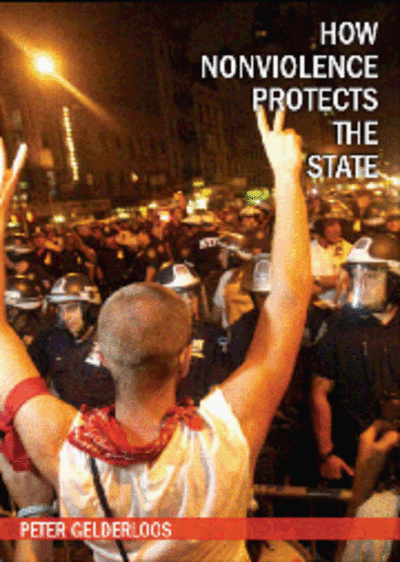
How Nonviolence Protects the State by Peter Gelderloos

How Nonviolence Protects the State by Peter Gelderloos
Available here or as a PDF here

Contents:
Introduction
Chapter One: Nonviolence is Ineffective
Chapter Two: Nonviolence is Racist
Chapter Three: Nonviolence is Statist
Chapter Four: Nonviolence is Patriarchal
Chapter Five: Nonviolence is Tactically & Strategically Inferior
Chapter Six: Nonviolence is Deluded
Chapter Seven: The Alternative: Possibilities for Revolutionary Activism

---

First off, I have to say that this is one of the best political books I've read all year (probably tied with The Coming Insurrection). It echoes a lot of what I believe about the ideology of nonviolence-only/pacifism. It also opened my eyes to other aspects of nonviolence that I had not thought about. Moreover, it covered what I tried to get at in my post on the Limits of Peaceful Resistance in a much better and more organized way, while still showing frustration.  When it was handed to me and I looked at the contents, I knew this was a book I would have to read. My friend told me I would love it, but I had no idea how much. I highly recommend this book to anyone who is interested in activism, even from a theoretical standpoint, and in particular to those who tout a pacifist-only ideology.

One of the first things Gelderloos tries to do in this book is dispel the idea that being against pacifism and nonviolent approaches does not mean one is necessarily pro-violence. I would not say I am pro-violence, but rather I support the diversity of tactics, which is what Gelderloos restates throughout the book: we don't need a staunchly pacifist bloc that will never really accomplish the ultimate goal of overthrowing capitalism, we need a diversity of tactics that may necessitate property destruction and armed struggle. He starts his argument with a discussion of how and when nonviolence has succeeded only as a result of armed blocs within a movement: the US Civil Rights Movement of the 1960s had the nonviolent face of Martin Luther King, Jr. who was co-opted by the state AND the militant faction of the Black Panthers who really showed the urgency of the movements; Gandhi was supported by the British and was easily maintained by the colonizers, but what really gave the urgency for the British to pull out of India was the armed uprisings of the Indian people elsewhere; the Hippie movement didn't really do anything to force the US Government to pull out of Vietnam, the fact that the Vietnamese people were relentlessly fighting against the US troops is what ultimately forced them to withdraw.

From there, Gelderloos builds his argument based on the chapter titles above. The main reason he gives for nonviolence being racist is that it often comes from a white person of privilege. How can someone who has never felt the brunt of racism tell someone in Oakland, for instance, who has to deal with racist police, to just turn the other cheek when the cops will not hesitate to shoot and kill even unarmed citizens? As Gelderloos shows, exclusively nonviolent practices are almost always preached by white people who coopt nonviolent figureheads but ignore the other aspects of their struggle, or ignore when they endorse the use of a diversity of tactics among other groups fighting for the same cause.

In the chapter "Nonviolence is Statist" explains how nonviolent protest is easily contained and managed by the state. Pacifists use approaches that are accepted by the state and happen in designated areas, where as militant property destruction can't be co opted and can't be contained. the police are not threatened by protesters who lock arms and sit in a human chain in the designated protest area, they are afraid of the people rioting in the streets, destroying bank windows, unafraid and going beyond what peaceful protest can do. In the chapter "Nonviolence is tactically & strategically inferior", Gelderloos reiterates that nonviolence can only get a movement to a specific point, but to go beyond it and overthrow capitalism and all forms of oppression, they will need to escalate their methods. He says,
[As] long as we continue to tolerate nonviolent leadership, the police will have us right where they want us. But if we refuse to de-escalate and to cooperate with the police, we can organize disruptive protests when they are needed and fight for the interests of our community or our cause without compromise. (103)
The alternative that he proposes is the necessity for the diversity of tactics. Nonviolent protesters need to stop the demonization of "violent" methods (which is even a debatable term since what may be violent to one person may not be considered violent to another), and violent protesters need to recognize that nonviolent methods do have there place. However, a strictly pacifist methodology will get us nowhere, as it will be easily contained, coopted, and put down by the state.

I highly recommend this book to everyone.

If you want to read a review from a nonviolent protester, one is located here.

~the GADFLY

Friday, November 19, 2010

What anarchism really means

As well as a tactic, direct action is also a means for self-empowerment. It is a component of the society we hope to create, where people take control of their lives into their own hands and confront the root causes of injustices directly, without representatives. This sometimes includes property damage, but anarchists take seriously the notions of liberty and equality: that people are capable of speaking and acting for themselves and become even more capable through practice rather than representation.
I saw this article entitled "What anarchism really means" and had to share it. It was written by the Anarchist Studies Network and appeared in the British daily newspaper The Guardian, which is a pretty mainstream news source. Check it out
http://www.guardian.co.uk/commentisfree/2010/nov/18/anarchism-direct-action-student-protests

- the Gadfly

Tuesday, November 2, 2010

theory of how college is like a game


[11/2/10 9:37:49 PM] person 1: hey, my friend patrick wants to know more on your theory of how college is like a game
[11/2/10 9:37:49 PM] person 1: please elaborate
[11/2/10 9:37:51 PM] person 1: for his sake
[11/2/10 9:37:53 PM] person 1: :)
[11/2/10 9:38:27 PM] person 2: alright give me a sec. just need to get through a couple things with j-money
[11/2/10 9:40:30 PM] person 2: essentially at this point in america, most decent to great jobs (monetarily and usually physically and emotionally "better" jobs) require at the very least a bachelors degree, if not a masters/phd
[11/2/10 9:43:17 PM] person 2: and your college education (academic education primarily) doesn't really have anything to do with the job you will be working. I for example am a sociology major. I can get a job doing research on race in a poor, immigrant community in some big city with a degree that has not actually taught me anything (except for one methods class) about actually going to do the research: how to communicate with people that probably view me as a privileged white outsider
[11/2/10 9:44:52 PM] person 2: what the degree really is suppose to prove is that you are a disciplined worker. I go to Middlebury, y'all two go to Hampshire. Both schools are considered rigorous and achieving good grades at our schools requires hard word. I bust my ass when i need to and definitely do a lot of work (though I spend a lot of time dicking around too).
[11/2/10 9:45:21 PM] person 2: thus when i apply for a job, i am showing them a piece of paper that says i am a disciplined, hard working.
[11/2/10 9:45:42 PM] person 2: my work in clubs. i'm a humanitarian, a leader, a good team player
[11/2/10 9:47:35 PM] person 2: at the end of the day, you totally learn some cool stuff at college, but it is less useful then actual lived experience. i should be able to prove that i am a hard worker just by working hard at a job, not paying a bunch of money to read, write, and talk a bunch about a bunch of sort of irrelevant things.
[11/2/10 9:48:43 PM] person 2: i therefore propose that if you can get away with doing really well in school while avoiding as much work as possible, you should do it
[11/2/10 9:50:32 PM] person 2: skip class, don't hand stuff in on time, stay out too late, or get high when you should be doing a reading
[11/2/10 9:50:42 PM] person 2: just make sure you don't start fucking up your grades
[11/2/10 9:51:10 PM] person 1: amen
[11/2/10 9:51:12 PM] person 1: :)

the G(L)ADFLY